Does Anything Have Higher Consciousness on Again for
Are we close to solving the puzzle of consciousness?
(Image credit:
Emmanuel Lafont
)
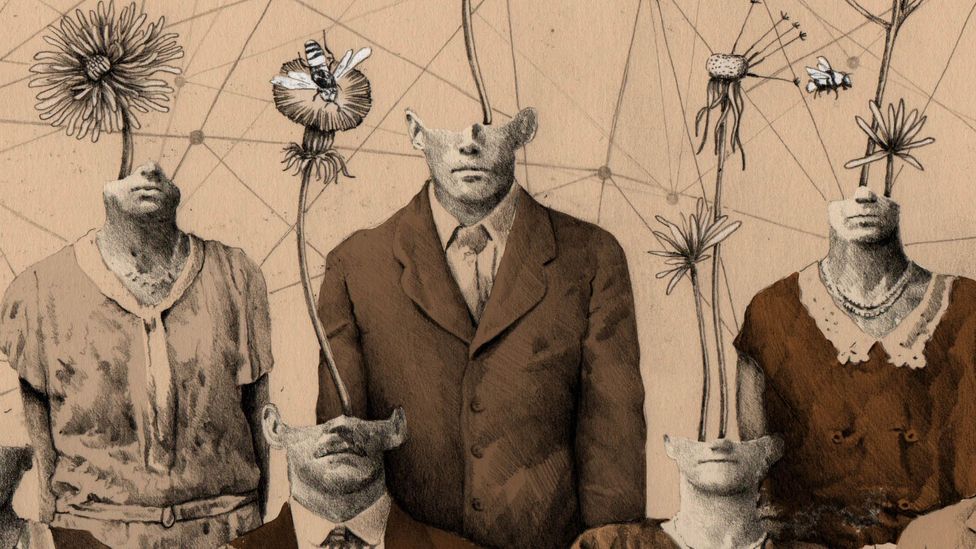
Giulio Tononi'southward "integrated information theory" might solve neuroscience's biggest puzzle
C
Can a lobster experience pain in the same style as you lot or I?
We know that they accept the same sensors – called nociceptors – that cause united states to blanch or cry when nosotros are injure. And they certainly conduct like they are sensing something unpleasant. When a chef places them in humid water, for example, they twitch their tails as if they are in agony.
But are they actually "aware" of the sensation? Or is that response merely a reflex?
When you or I perform an action, our minds are filled with a complex witting experience. We can't simply assume that this is also truthful for other animals, still – particularly ones with such different brains from our own. It's perfectly feasible – some scientists would even argue that it'southward likely – that a animal like a lobster lacks any kind of internal experience, compared to the rich world inside our caput.
"With a dog, who behaves quite a lot like u.s.a., who is in a trunk which is not too different from ours, and who has a brain that is not as well dissimilar from ours, it'southward much more plausible that it sees things and hears things very much similar we do, than to say that it is completely 'dark inside', so to speak," says Giulio Tononi, a neuroscientist at the University of Wisconsin-Madison. "Just when it comes down to a lobster, all bets are off."
The question of whether other brains – quite alien to our own – are capable of awareness, is just ane of the many conundrums that arise when scientists kickoff thinking about consciousness. When does an awareness of our ain being first emerge in the brain? Why does it feel the way it does? And will computers ever be able to accomplish the same internal life?
Tononi may have a solution to these puzzles. His "integrated information theory" is ane of the most heady theories of consciousness to take emerged over the last few years, and although it is not yet proven, information technology provides some testable hypotheses that may presently requite a definitive reply.
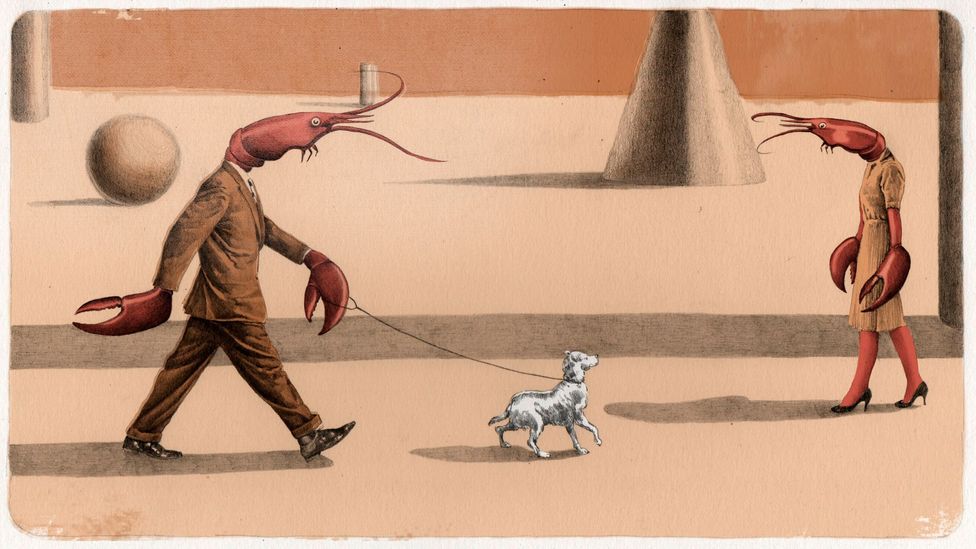
We currently accept no way of knowing whether lobsters have a conscious inner life - or if their behaviour is purely reflex (Credit: Emmanuel Lafont)
Tononi says his fascination arose equally a teenager with a "typically adolescent" preoccupation with ethics and philosophy. "I realised that knowing what consciousness is and how it came nigh is crucial to understanding our place in the universe and what nosotros practise with our lives," he says.
At that historic period, he did not know the all-time path to follow to pursue those questions – Would it be mathematics? Or philosophy? – but he somewhen settled on medicine. And the clinical feel helped to fertilise his immature mind. "At that place is really something special about having a direct exposure to neurological cases and psychotic cases," he says. "It really forces you to face directly what happens to patients when they lose consciousness or lose the components of consciousness in ways that are really difficult to imagine if you lot didn't run across that it really happens."
In his published research, however, he built his reputation with some pioneering work on sleep – a less controversial field. "At that time yous couldn't even talk about consciousness," he says. Just he kept on mulling over the question, and in 2004, he published his first description of his theory, which he has subsequently expanded and developed.
You lot might too like:
- Blindsight: the strangest class of consciousness
- What happens when anaesthesia fails
- What Peter Pan teaches us about retentivity and consciousness
Information technology begins with a gear up of axioms that define what consciousness really is. Tononi proposes that any conscious experience needs to be structured, for instance – if you lot look at the infinite around you, you lot tin distinguish the position of objects relative to each other. It'south also specificand "differentiated" – each experience volition be different depending on the particular circumstances, meaning at that place are a huge number of possible experiences. And it is integrated. If you look at a red book on a table, its shape and color and location – although initially candy separately in the brain – are all held together at in one case in a single conscious experience. We even combine information from many different senses – what Virginia Woolf described equally the "incessant shower of innumerable atoms" – into a single sense of the here and at present.
From these axioms, Tononi proposes that we can identify a person'south (or an creature's, or even a computer's) consciousness from the level of "information integration" that is possible in the brain (or CPU). Co-ordinate to his theory, the more information that is shared and processed between many unlike components to contribute to that unmarried experience, so the higher the level of consciousness.
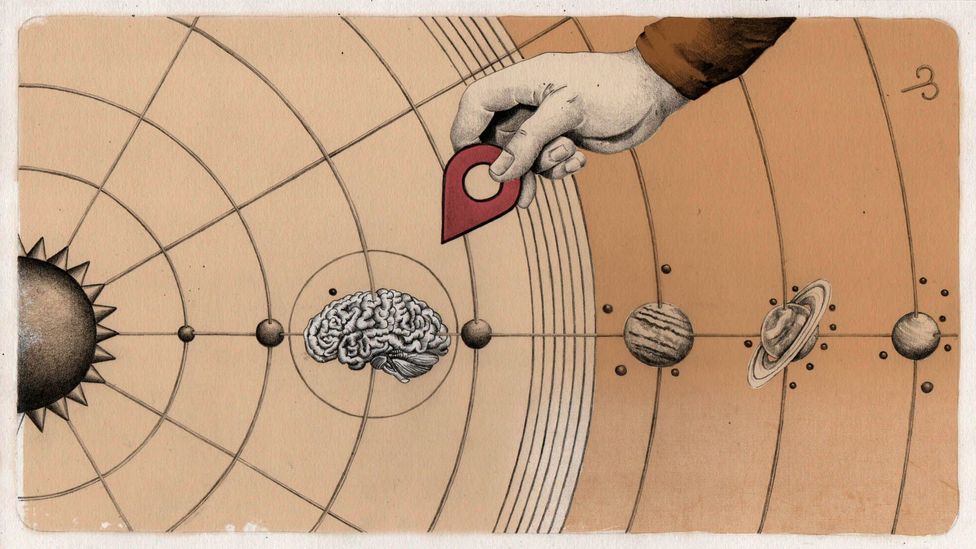
Giulio Tononi'south theory asserts that consciousness arises from sure kinds of information processing (Credit: Emmanuel Lafont)
Perhaps the best mode to sympathise what this means in practise is to compare the brain's visual system to a digital photographic camera. A camera captures the light striking each pixel of the image sensor – which is conspicuously a huge amount of total information. Simply the pixels are not "talking" to each other or sharing information: each one is independently recording a tiny part of the scene. And without that integration, it can't accept a rich witting experience.
Like the digital camera, the man retina contains many sensors that initially capture pocket-size elements of the scene. Merely that information is then shared and processed across many different brain regions. Some areas volition be working on the colours, adapting the raw data to make sense of the low-cal levels so that nosotros can nonetheless recognise colours fifty-fifty in very unlike conditions. Others examine the contours, which might involve guessing the parts of an object are obscured – if a coffee loving cup is in front of function of the book, for case – so you withal get a sense of the overall shape. Those regions volition and so share that data, passing it further up the bureaucracy to combine the different elements – and out pops the conscious experience of all that is in front of us.
The aforementioned goes for our memories. Unlike a digital photographic camera'southward library of photos, we don't store each experience separately. They are combined and cross-linked to grade a meaningful narrative. Every time we experience something new, it is integrated with that previous data. It is the reason that the sense of taste of a unmarried madeleine can trigger a memory from our distant babyhood – and it is all part of our witting experience.
At to the lowest degree, that's the theory – and information technology's compatible with many observations and experiments across medicine.
One study, published in 2015, examined the brains of participants under diverse forms of anaesthesia – including propofol and xenon. To get an idea of the encephalon'south chapters to integrate information, the team applied a magnetic field above the scalp to stimulate a pocket-size area of the cortex underneath – a standard not-invasive technique known as Transcranial Magnetic Stimulation (TMS). When awake, you would discover a complex ripple of activity equally the encephalon responds to the TMS, with many different regions responding, which Tononi takes to exist a sign of information integration betwixt the unlike groups of neurons.
Simply the brains of the people under propofol and xenon did non show that response – the brainwaves generated were much simpler in class compared to the hubbub of activity in the awake encephalon. By altering the levels of of import neurotransmitters, the drugs appeared to have "broken down" the encephalon's information integration – and this corresponded to the participants' consummate lack of awareness during the experiment. Their inner experience had faded to black.
Drug-induced fantasies
As a further comparison, the squad likewise looked at participants under ketamine. Although the drug renders you lot unresponsive to the outside earth – meaning that it is also used equally an anaesthetic – the patients frequently report wild dreams, every bit opposed to the pure "bare" experienced under propofol or xenon. Sure enough, Tononi'due south team plant that the responses to the TMS were far more than complex than those under the other anaesthetics, reflecting their altered state of consciousness. They were asunder from the exterior earth, but their minds were nevertheless very much turned on during their drug-induced fantasies.
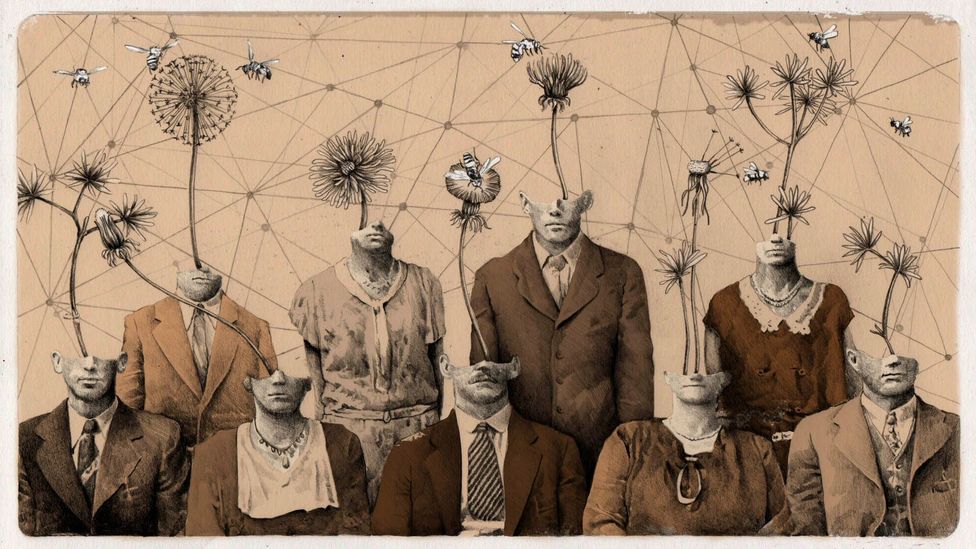
Consciousness remains ane of science'south greatest mysteries (Credit: Emmanuel Lafont)
Tononi has found similar results when examining dissimilar slumber stages. During not-REM slumber – in which dreams are rarer – the responses to TMS were less complex; but during REM sleep, which oftentimes coincides with dream consciousness, the information integration appeared to be higher.
He emphasises that this isn't "proof" that his theory is correct, but it shows that he could be working on the right lines. "Let'due south say that if we had obtained the opposite result, we would accept been in trouble."
Tononi'south theory besides chimes with the experiences of people with diverse forms of brain harm. The cerebellum, for example, is the walnut-shaped, pinkish-grey mass at the base of the encephalon and its prime number responsibility is coordinating our movements. It contains four times as many neurons every bit the cortex, the bark-like outer layer of the brain – around half the total number of neurons in the whole brain. Nevertheless some people lack a cerebellum (either because they were born without information technology, or they lost it through encephalon damage) and they are notwithstanding capable of conscious perception, leading a relatively long and "normal" life without whatever loss of awareness.
These cases wouldn't make sense if y'all just consider the sheer number of neurons to be important for the cosmos of conscious feel. In line with Tononi'southward theory, however, the cerebellum'southward processing mostly happens locally rather than exchanging and integrating signals, significant it would have a minimum part in awareness.
Measures of the brain'southward responses to the TMS too seem to predict the consciousness of patients in a non-communicative and vegetative state – a finding with potentially profound clinical applications.
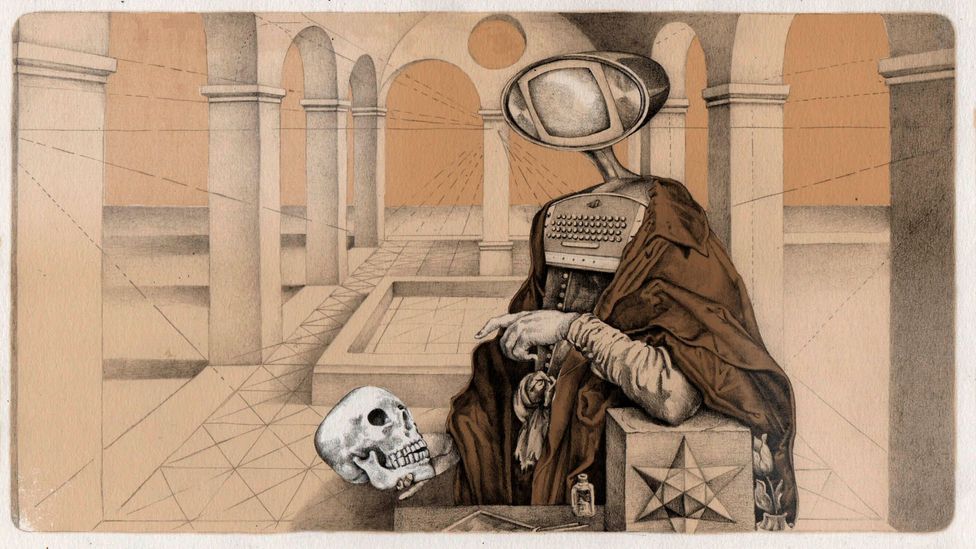
The integrated information theory could help predict whether computers volition e'er become witting (Credit: Emmanuel Lafont)
Peachy claims crave nifty bear witness, of course – and few scientific questions are more profound than the mystery of consciousness.
Tononi's methods and so far only offer a very crude "proxy" of the brain'south information integration – and to really evidence his theory'south worth, more sophisticated tools will be required that tin precisely measure processing in whatever kind of brain.
Daniel Toker, a neuroscientist at the University of California Berkeley, says the idea that information integration is necessary for consciousness is very "intuitive" to other scientists, but much more bear witness is required. "The broader perspective in the field is that it is an interesting idea, but pretty much completely untested," he says.
It all comes down to mathematics. Using previous techniques, the fourth dimension taken to measure information integration across a network increases "super exponentially" with the number of nodes you are considering – meaning that, fifty-fifty with the best technology, the ciphering could concluding longer than the lifespan of the universe. But Toker has recently proposed an ingenious shortcut for these calculations that may bring that downwards to a couple of minutes, which he has tested with measurements from a couple of macaques. This could be one commencement stride to putting the theory on a much firmer experimental footing. "Nosotros're really in the early stages of all this," says Toker.
Only then can we brainstorm to respond the actually big questions – such as comparing the consciousness of dissimilar types of brain. Fifty-fifty if Tononi'due south theory doesn't prove to be true, however, Toker thinks it'southward helped to push other neuroscientists to retrieve more than mathematically about the question of consciousness – which could inspire future theories.
And should information integration theory be right, it would be truly game changing – with implications far beyond neuroscience and medicine. Proof of consciousness in a creature, such as a lobster, could transform the fight for animal rights, for case.
It would besides answer some long-continuing questions nigh artificial intelligence. Tononi argues that the basic compages of the computers nosotros have today – made from networks of transistors – preclude the necessary level of information integration that is necessary for consciousness. So even if they can be programmed to behave like a human, they would never take our rich internal life.
"At that place is a sense, according to some, that sooner rather than after computers may be cognitively as adept equally we are – not just in some tasks, such every bit playing Go, chess, or recognising faces, or driving cars, but in everything," says Tononi. "But if integrated information theory is right, computers could behave exactly like you and me – indeed you might [fifty-fifty] be able to have a chat with them that is as rewarding, or more rewarding, than with you or me – and yet there would literally be nobody at that place." Again, it comes down to that question of whether intelligent behaviour has to arise from consciousness – and Tononi's theory would suggest it'south not.
He emphasises this is not only a question of computational ability, or the kind of software that is used. "The physical architecture is always more or less the same, and that is e'er not at all conducive to consciousness." So thankfully, the kind of moral dilemmas seen in serial like Humans and Westworld may never become a reality.
It could even help usa understand the means we interact with each other. Thomas Malone, director of the Massachusetts Institute of Technology'southward Center for Collective Intelligence and writer of the book Superminds, has recently practical the theory to teams of people – in the laboratory, and in real-world, including the editors of Wikipedia entries. He has shown that the estimates of the integrated information shared past the team members could predict group performance on the various tasks. Although the concept of "grouping consciousness" may seem like a stretch, he thinks that Tononi's theory might assist us to understand how large bodies of people sometimes begin to call up, feel, remember, determine, and react as one entity.
He cautions this is yet very much speculation: nosotros first need to be sure that integrated data is a sign of consciousness in the individual. "But I do think it'south very intriguing to consider what this might mean for the possibility of groups to be conscious."
For now, we still tin can't be sure if a lobster, computer or fifty-fifty a society is conscious or not, merely in the future, Tononi's theory may assist us to empathise 'minds' that are very alien to our ain.
--
David Robson is a senior journalist at BBC Future. He is @d_a_robson on Twitter. This piece contains original artwork by Emmanuel Lafont, an Argentinian-born visual artist currently working in Spain. He is represented by Yusto/Giner and past 6a Galeria D'art. His website is www.emmanuellafont.com.
Join 900,000+ Time to come fans past liking us on Facebook , or follow united states of america on Twitter or Instagram .
If you liked this story, sign up for the weekly bbc.com features newsletter , called "If You Only Read 6 Things This Calendar week". A handpicked selection of stories from BBC Future, Culture, Uppercase, and Travel, delivered to your inbox every Fri.
Source: https://www.bbc.com/future/article/20190326-are-we-close-to-solving-the-puzzle-of-consciousness
0 Response to "Does Anything Have Higher Consciousness on Again for"
Post a Comment