If You Change Your I 20 Status Again Have to Pay Sevis Fee Again
The Form I-20 (also known as the Certificate of Eligibility for Nonimmigrant (F-1) Student Status-For Academic and Language Students) is a Us Department of Homeland Security, specifically ICE and the Pupil and Exchange Visitor Program (SEVP), document issued by SEVP-certified schools (colleges, universities, and vocational schools) that provides supporting data on a pupil's F or M condition.[1] [2] Since the introduction of the Student and Exchange Visitor Information Organisation (SEVIS) run past SEVP, the form also includes the educatee tracking number (SEVIS ID number) and school code. The Form I-20 is but for F-i, F-2, M-1, and M-2 statuses. J-one and J-2 status holders take an equivalent Grade DS-2019 which is issued by a United States Department of Country-designated J exchange visitor program.
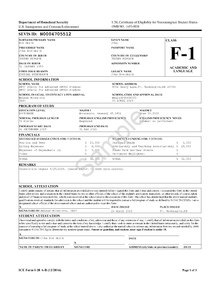
Course I-20, Document of Eligibility for Nonimmigrant (F-1) Student Condition-For Academic and Language Students
Structure [edit]
Current structure of I-20 [edit]
The I-20 was updated starting June 2015, with all new I-20s issued using the new format starting June 26, 2015, and the new I-20 necessary for all students seeking entry or re-entry starting July 2016. The chief reason for the update to the form was the standardization of names in SEVIS. The changes include:[iii]
- More prominence to the SEVIS number.
- Better separation of student information from dependent information.
- Expandable field boxes that display information about cap gap extension, change of condition, event history and other authorizations.
- General design improvements that include moving the instructions to the third page of the Course I-twenty, besides as the removal of the barcode, and the blocks for visa and port of entry information.
- The new Request Mass Reprint functionality that allows DSOs to reprint Forms I-20 for multiple students at a time.
The new Form I-20 is 3 pages long. Each dependent gets an additional three pages, with the same format.[four]
Folio 1 contains the following:
- The SEVIS ID (printed in bold on top)
- Student's biographical information: diverse kinds of names, countries of birth and citizenship, and appointment of nativity
- The class of admission (F-1 or Yard-1; in case of boosted pages added for dependents, the course of admission is F-2 or M-ii)
- School information (schoolhouse proper noun, school accost, schoolhouse SEVIS code, and name of the DSO)
- Information nigh the program of written report: Program name, education level, normal plan length, showtime and finish date, English proficiency
- Financial information for the kickoff year of studies, with one cavalcade for estimated funding costs and some other column for funding sources
- Remarks
- School testament, signed and dated by the DSO
- Educatee attestation, signed and dated by the educatee
Page two contains the following (this is information that appeared on Page 3 in the previous I-20):
- Employment say-so (such as for Optional Practical Training or Curricular Practical Preparation)
- Information on modify of status or the cap-gap extension (for post-completion OPT)
- Result history (as a table)
- Other authorizations (as a table)
- Travel signatures
In the case of long event histories, Page 2 could spill over to multiple pages.
Folio 3 contains instructions.
Structure of I-20 until June 2015 [edit]
The Course I-20 used until June 2015 has 3 pages, of which the 2d folio was an instructions folio, so that only the first and third pages contained data specific to the student's SEVIS record.[5]
Page 1 contains the following:
- SEVIS number
- Student'south biographical information (name, country of birth, state of citizenship)
- Information virtually the school and Designated School Official who needs to be informed upon the student's arrival
- The educatee's degree program, reporting date, and plan end date.
- How the student intends to run across his/her first year of expenses.
- Proper name and signature of the DSO, along with the appointment.
- Name and signature of the student, along with the date.
Page 3 includes the following:
- The educatee'south name
- Data on whatsoever work authorization, including Optional Practical Training and Curricular Practical Training
- A section for travel signatures. A travel signature at most 1 year old is necessary whenever re-inbound the United States
An additional Page 4 may be included for information on the pupil's dependents, if whatsoever.
Overall office [edit]
SEVP-certified establishment [edit]
The Form I-xx is issued by a Designated Schoolhouse Official (DSO) at the institution (college, university, or vocational school). But institutions that are SEVP-certified can effect Form I-20s. An institution can acquire SEVP certification by filing Form I-17 with U.S. Immigration and Customs Enforcement (this is a one-time process).[half dozen] Note that an institution can be SEVP-certified despite not holding national or regional accreditation.[2] Conversely, an institution may hold national or regional accreditation only may have chosen not to obtain SEVP certification if it does non intend to admit international students in the F, J, or 1000 status.
A big academy typically has an international office that manages its participation in the SEVP, and all the DSOs work for this office. The international function manages updates to the SEVIS record and issuing of new paper Form I-20s. Students who have any change to their plans (such equally program end date, course load, leave of absence, render from exit of absenteeism) must communicate these changes with their international office.
Student SEVIS record and Form I-twenty [edit]
At the fourth dimension the get-go Form I-20 is issued to the student (after accepting the offer of access from the establishment) a tape is created for the student in the Educatee and Exchange Company Information System (SEVIS). At whatever given time, the responsibility for keeping the student'southward SEVIS record up to date falls with the SEVP-certified institution the student is currently enrolled in. If the student transfers to a different SEVP-certified institution, the responsibility of updating the SEVIS record now falls on the new institution.[seven]
The Form I-20 can exist idea of as a paper representation of the nigh upward-to-date SEVIS information on tape for the student's current enrollment. Whenever there are substantive changes to the information, the SEVIS record is updated, and a new Form I-20 is issued to the student by the institution with the updated information. The student must utilize the most up-to-date Course I-xx when demonstrating student condition.[8]
Process [edit]
Issuance of first Class I-20 [edit]
In one case the prospective student has accustomed the institution'southward offer of access, the institution issues a Course I-20 to the pupil.[1] [two]
Autonomously from biographical data nearly the pupil (including the student's proper name, date of nascence, citizenship, etc.), in that location are 2 main pieces of information that must be entered in the student's SEVIS tape and the initial Form I-20.
- Programme details: The programme name, first date, and finish date.
- How the student intends to see tuition and living expenses for the first year the pupil is in the programme, or until the end date indicated on the I-20, whichever is shorter.
Each international part may follow its ain rules or guidelines regarding the blazon of documentation it requests from the pupil or from other departments in order to be able to issue the I-20. The jargon used for this documentation volition likewise vary by institution. For instance, the University of Chicago and Academy of Michigan uses the term "Fiscal Resources Statement" for the statement that students need to submit to it regarding how they will meet their expenses,[9] [10] while the University of Illinois at Urbana–Champaign uses the term "Declaration & Certification of Finances for I-20/DS-2019 Application".[11]
After receiving information from the student and establishment regarding the program length and cease date, the international office creates the educatee'south SEVIS record, gets a SEVIS number for the student, and issues a Class I-20. A concrete copy of the grade may exist mailed to the student overseas. In the example that the student has a SEVIS record from previous educatee status, the existing SEVIS record should be transferred.[7]
The international office may refuse to result a Course I-20 if the pupil is unable to demonstrate how he or she plans to cover expenses for the beginning twelvemonth.
Utilise of Form I-20 while transitioning to educatee condition [edit]
The Form I-xx is used in the following stages of the transition to student condition in the U.s.a.:
- The SEVIS number on the I-20 is needed while paying the SEVIS fee.[12]
- It is needed when applying for the F visa or M visa, both when filling the awarding form and during the interview.[ citation needed ]
- Information technology is needed when seeking admission to the Us. At the time of admission, a valid visa likewise as a valid I-20 are needed. At the time of initial entry, the officeholder at the port of entry checks that the program commencement date is at most thirty days ahead, and that the I-20 has a valid travel signature.[13] It is besides necessary that, at the time of initial entry, the schoolhouse the student intends to nourish matches the schoolhouse on the student'southward visa and the student'south I-xx, though this is not a requirement in the future.[vii] The officeholder at the port of entry likewise issues a Class I-94 with expiration date indicated as "D/S" (Duration of Status), which ways that the educatee is in authorized status in the United States until the programme terminate date indicated on the I-twenty (and can stay in the United states of america for up to sixty days afterward that).
- For those who are not seeking admission to the U.s. only merely changing status, a copy of the Form I-twenty needs to be attached along with the Class I-539 application to change condition.[fourteen]
For those entering the United States in student status, the engagement of entry to the United States is treated as the showtime date for the student being in the F or 1000 student status (even if this is before the program start date). For those transitioning to student status from another status, the appointment of transition indicated on the Form I-539 is treated as the offset engagement.
Subsequent use of Form I-20 [edit]
Establishing legality of condition and stay [edit]
The Form I-20 serves as evidence of the legality of the student's current presence in the United States. Notation that a valid visa is not necessary for being in lawful educatee status; a valid visa is only needed when entering or re-entering the United states.[fifteen]
Documentation of student condition for The states government purposes [edit]
The Form I-20 may be used to demonstrate student status when applying for Usa authorities documents and benefits such equally Private Taxpayer Identification Number (ITIN) and Social Security Number.[16] Information technology is likewise required to demonstrate authorization to work for students on Curricular Practical Training.[17]
Travel and travel signatures [edit]
Whenever the student re-enters the United States after traveling, the student must accept all of these at the time of arrival at the port of entry:[18]
- A valid passport (valid for at to the lowest degree vi more than months)
- A valid F or 1000 visa
- A valid I-20 (i.e., an I-xx whose plan end appointment has non however arrived)
- A travel signature on the I-20 (page 3) from the DSO that is at almost i year old (six months in the case of students currently on post-completion Optional Practical Training)
Since travel signatures are valid for only a twelvemonth, students need to periodically get updated travel signatures on their I-20 from their international student office. The purpose of this requirement is to avoid cases where people who are no longer enrolled equally students at an institution keep using an outdated Form I-20 to go far. In particular, when adding a new travel signature to the OPT, it is the responsibility of the international student office to make certain that the student is still enrolled at the institution. In instance the Form I-20 runs out of space for travel signatures, the international function may impress out a new Form I-20 for the educatee.
In the special case of automatic visa revalidation, whereby the student returns to the United States after a trip to Canada, Mexico, or a nearby isle for at most 30 days, information technology is non necessary to have a valid visa at the time of re-entry. However, it is still necessary to have a valid Grade I-twenty and a travel signature.[nineteen]
Changes to Form I-20 [edit]
In general, whenever there are changes to the data in Form I-20, a new Form I-twenty is issued.[eight] The student is advised to keep all historical Forms I-twenty for the record merely only the most recent copy should be used for travel or as proof of current educatee status.
Changing the plan terminate date [edit]
It may happen that the student's actual plan end date falls earlier or later than what the student expected. It is necessary that a new I-20 be issued reflecting the current plan end engagement, both prior to the program's actual cease and prior to the stated program end date on the Grade I-20.
If the Form I-20 is being shortened, the international office may require the educatee to submit evidence showing that the student has plenty bookish credits to graduate early on.[xx] If the Course I-20 is being extended, then, in addition to whatever show from the student most changed academic plans, the international part also needs an updated argument of fiscal resources for the new I-20 to cover upwards to i yr of the I-20 extension.
After the change to the programme end appointment is fabricated in the educatee's SEVIS record, the new Class I-twenty is issued to the pupil.
It is important to annotation that the program end date on the Course I-twenty demand not coincide with the graduation date. Rather, it is the end date of the student's enrollment in courses. It is not possible to extend the plan end date simply in lodge to exist able to stay around till the graduation anniversary. If the graduation anniversary falls exterior the 60-mean solar day grace period of completion of coursework, and then the pupil must find some other way to be legally present for information technology (for instance, by staying around on Optional Practical Training, or getting a B visa for the graduation ceremony).[20]
Other changes [edit]
The following are some other types of major updates to the student's SEVIS record that require changes to the Form I-xx. In all cases, the student must contact the international office beforehand and have a new I-twenty issued in advance:[21]
- Reduced Course Load: This means that the student is not enrolled as a total-time pupil. Reasons for granting RCL include final quarter/semester, medical condition, and academic difficulties. Academic difficulties in turn include improper class level placement, academic difficulties with the English language language, or unfamiliarity with American teaching methods.[21] [22]
- Applied Training, including Optional Practical Grooming (pre-completion and mail service-completion) and Curricular Practical Grooming[23]
- Leave of Absenteeism and Withdrawal[24]
See also [edit]
- College admissions in the United States
- F-1 visa
- J-i visa
- M-1 visa
References [edit]
- ^ a b "What is the Form I-20?". January 28, 2013. Retrieved February nine, 2016.
- ^ a b c "International Student Visas". EducationUSA. Retrieved Feb ix, 2016.
- ^ "Coming Soon: A Redesigned Form I-20". June 18, 2015. Retrieved February 10, 2016.
- ^ "I-xx, Certificate of Eligibility for Nonimigrant Student Status" (PDF).
- ^ "SAMPLE Document of Eligibility I-xx (for F visa holders)" (PDF). Brandeis Academy. Archived from the original (PDF) on 2015-09-12. Retrieved 2016-02-x .
- ^ "Overview of the SEVP certification process". U.S. Immigration and Customs Enforcement. Retrieved February 9, 2016.
- ^ a b c "Transfers for F-1 Students". U.Due south. Immigration and Customs Enforcement. Retrieved February 9, 2016.
- ^ a b "Requirements of Schools Seeking F & Thousand Certification". U.South. Immigration and Community Enforcement. Retrieved February x, 2016.
- ^ "Qualifying for your I-20 or DS-2019". University of Chicago. Retrieved Feb 9, 2016.
- ^ "Financial Resources Statement for Issuance of Class I-20 or DS-2019" (PDF) . Retrieved February 9, 2016.
- ^ "Declaration & Certification of Finances for I-20 / DS-2019 Application FOR INTERNATIONAL APPLICANTS But" (PDF) . Retrieved Feb 9, 2016.
- ^ "Pupil and Substitution Visitor Program: I-901 Fee". U.S. Immigration and Community Enforcement. Retrieved February 10, 2016. [ permanent expressionless link ]
- ^ "Arriving in the U.South. at the Drome or the Port of Entry". Retrieved February nine, 2016.
- ^ "I am a nonimmigrant. How practise I alter to another nonimmigrant condition?" (PDF). United states of america Citizenship and Immigration Services. Retrieved February ane, 2016.
- ^ "Visa vs. Status: One can elapse; the other may not!". Academy of Chicago. Retrieved Feb 10, 2016.
- ^ "International Students And Social Security Numbers" (PDF). Social Security Administration. Retrieved February 10, 2016.
- ^ "Additional Documentation Requirements". U.s. Citizenship and Clearing Services.
- ^ "Travel Signatures". Retrieved Feb nine, 2016.
- ^ "Travel & Visas". Retrieved February ix, 2016.
- ^ a b "Finishing Courses Before Than I-20/DS-2019 End Date". University of Chicago. Retrieved February nine, 2016.
- ^ a b "Dropping a Grade, Withdrawal, and On-Leave Status". University of Washington. Archived from the original on 2016-02-16.
- ^ "Maintaining a Total Time Class Load". University of Chicago.
- ^ "OPT (Optional Practical Training)". University of Chicago. Retrieved Feb 10, 2016.
- ^ "Get out of Absence and Withdrawal". University of Chicago. Retrieved February x, 2016.
Source: https://en.wikipedia.org/wiki/I-20_(form)
0 Response to "If You Change Your I 20 Status Again Have to Pay Sevis Fee Again"
Post a Comment